It was a downside not to be able to revisit my memories of standing on a canal boat and feeling the floor move beneath my feet - and perhaps the detrimental effects of quite such a large sugar and fat blast on my waistline and teeth. Dangerously, I've discovered that the pork scratchings are available by post: can't see that I'm going to be able to resist indulging again, although perhaps I'll just partner them with the Pernod next time …
Eclectic musings from a girl about London town. Cricket, films, food, buses, walking London's streets, river, parks and bridges, card-making and all sorts of other stuff that grabs my attention.
Showing posts with label London. Show all posts
Friday, 13 May 2011
Canalway Cavalcade
The Ashes Revisited (1981)
One film about cricket being shown at the cinema is an unusual event but this week there have been two: Fire in Babylon and From the Ashes. Remarkable. Both are documentaries that make extensive use of original footage, supplemented by insightful, honest and revealing interviews, contemporary and recent, with the main protagonists and journalists. Each has had a one off showing across the UK, followed by a live satellite Q&A session from a London cinema. Both will shortly be on general cinema release, quickly followed by DVDs.
Fire in Babylon is about the emergence of the great West Indian cricket team, with its stars Viv Richards, Clive Lloyd and Michael Holding, and directed by Stevan Riley. From the Ashes, directed by James Erskine, is about the 1981 England v Australia series, which is generally known as "Botham's Ashes" but is actually about far more.
I certainly didn't watch, analyse and dwell upon every moment of the 1981 Ashes series as I have with the more recent ones. It was, however, when I first became aware of cricket, and started to try to work out some of complexities of the game. Oddly, I don't have my own memories of either Botham's anguishes and failures before he was relieved of the England captaincy, or of his heroic and liberated batting and bowling afterwards, although I have, of course, seen much footage of all of that many times since. My memories from the time are of Kim Hughes, the blond, stylish and dashing Australian captain, in the field, Bob Willis's amazingly focussed, some have said crazed, bowling spell at Headingley, and the calm, shrewd and effective captaincy of Mike Brearley, the amazing effect of which was obvious even to a confused novice like me.
All of this, and much more, appears in the documentary, alongside political and social events at the time in the UK, backed by a terrific soundtrack, with which I didn't manage to resist singing along. I gained insight into the huge challenges that Kim Hughes endured from members of the Australian team, such as Dennis Lillee and Rod Marsh, who were disrespectful to him and his office - and freely admitted so. I appreciated just how fragile the situation was at Headingley and that it could just as easily, if not even more easily, gone horribly wrong rather than marvellously right. I heard Willis, Brearley and Botham express insecurities about their position in the team and how they were viewed by management and fellow players. And it was clear once again that every successful Ashes series has at least one player for whom it was not a personal playing triumph: encouraging to hear the great David Gower admit that in 1981 it was him.
There can't be an England cricket fan who doesn't know the outcome of the 1981 series, nor that it turned on Botham's performance at Headingley, but there was plenty new in the film for me, and I imagine that many others - of all ages - may find that their understanding, appreciation and memories are enhanced by these 90 minutes of cricket. The portrayal of some of the social and political events of the time - riots on city streets, recession, a fairly new Conservative Prime Minister, and a Royal Wedding - are interesting, not least in their parallels to today. It's also intriguing to see how life has changed for England cricket stars: much enhanced pay, benefits and lifestyle, but also much less freedom, and opportunity to live as normal men.
Such was my enjoyment of what I gained - from the film and the Q&A afterwards - that I'll gallantly forgive the film-makers for a shot of an inappropriate dial telephone. It was certainly old enough to have been used in 1981 and the number was for the Marylebone exchange, so might have been Lord's, but the dialling code was wrong. In 1981, London still had its famous, and rightful, 01 code; 071 was not introduced until the other end of the decade. Once a telephone engineer's daughter, always a telephone engineer's daughter!
The Ashes Revisited (2010/11)
This week, the documentary film From the Ashes allowed us to revisit England's 1981 Ashes victory. Last week, however, it was last winter's win that I was reliving. And in the actual, rather than satellite, presence of one of the main participants: Andrew Strauss, the double Ashes winning captain no less. Courtesy, it cannot be said too often or with too much gratitude, of Simon "The Cricket Analyst" Hughes, who ran a Twitter competition. Anyone who considers Twitter to be a complete waste of time might just want to think again.
When Simon announced on Twitter that he'd be running a competition for an evening with Mr Strauss re-enjoying last winter's cricket down under, I assumed that (a) the question would be completely impossible (certainly a characteristic of other competitions that the Analyst has run on Twitter) and (b) the world, his brother, his dog and Geoffrey Boycott's grandmother would enter. The task was to identify a player on the Cricket Analyst mobile app (iPhone/Android), which some might cynically think was a sales ploy. Even if it was, the purchase price was insignificant compared to the prestige of the prize. Anyway, I had already obtained the app for a bargain price at the end of some irrelevant one-day international tournament held on the sub-continent. I assumed that the player would be someone very obscure. Actually, it was Brad Hogg and, very helpfully, the app told me so. I emailed my answer off to Simon, wished him well with sorting through the avalanche of replies and hoped that he, Mr Strauss and the lucky winners would have a very happy evening. Then I moved on to waste (sorry, invest) time on some other pursuit.
I think that there were two factors in my favour. One, the competition was running early-afternoon in the middle of the week. Two, and possibly more significant, entry was to be made by email not Twitter reply; plenty of people didn't seem to have noticed that. When an email from Simon Hughes dropped in my inbox, I assumed that it was of the polite "sorry, but thanks for your interest" kind. Amazingly, no, I had won. I thanked him immediately and profusely and then checked that the prize was two tickets. Apparently, no, it was only supposed to be one, but he was prepared to make an exception. More thanks, apologies for seeming cheeky and off to break the news to my best cricket girlfriend.
We saw, cheered and clapped lots of footage from the five Test Matches. Simon Hughes asked our captain lots of decent questions and an occasional rubbish one. We knew how Mr Strauss had felt getting out to the third ball of the series: we'd all watched and endured it with him - and feared what disaster might follow. He handled them all with aplomb, humour and honesty. Time flew by, we got some good insight into how our captain felt about his own performance, those of some of his fellow players, and what he thought of the Australian captain's "new" hair (amongst other things).
Whoever had the very bright idea of serving a supper of curry and rice was a genius; whoever thought that an early-May evening event in a marquee in London did not need heating was not. It was terrific to relive those memories, and in such special company, but it would have been even more fab if it hadn't been quite so chilly. (Memories of the MCG on Boxing Day 2006 returned.) Finally, the video footage reached the marvellous moment when Strauss raised the urn, red and white tickertape fell and I felt almost as excited as I had four months earlier. There was a raffle for charity. Someone won a bat: not me, but I felt that I'd been plenty lucky enough just to be there.
When Simon announced on Twitter that he'd be running a competition for an evening with Mr Strauss re-enjoying last winter's cricket down under, I assumed that (a) the question would be completely impossible (certainly a characteristic of other competitions that the Analyst has run on Twitter) and (b) the world, his brother, his dog and Geoffrey Boycott's grandmother would enter. The task was to identify a player on the Cricket Analyst mobile app (iPhone/Android), which some might cynically think was a sales ploy. Even if it was, the purchase price was insignificant compared to the prestige of the prize. Anyway, I had already obtained the app for a bargain price at the end of some irrelevant one-day international tournament held on the sub-continent. I assumed that the player would be someone very obscure. Actually, it was Brad Hogg and, very helpfully, the app told me so. I emailed my answer off to Simon, wished him well with sorting through the avalanche of replies and hoped that he, Mr Strauss and the lucky winners would have a very happy evening. Then I moved on to waste (sorry, invest) time on some other pursuit.
I think that there were two factors in my favour. One, the competition was running early-afternoon in the middle of the week. Two, and possibly more significant, entry was to be made by email not Twitter reply; plenty of people didn't seem to have noticed that. When an email from Simon Hughes dropped in my inbox, I assumed that it was of the polite "sorry, but thanks for your interest" kind. Amazingly, no, I had won. I thanked him immediately and profusely and then checked that the prize was two tickets. Apparently, no, it was only supposed to be one, but he was prepared to make an exception. More thanks, apologies for seeming cheeky and off to break the news to my best cricket girlfriend.
Joining instructions required us to make our way to The Park Club in west London (a very obscure part of town for me) and to be attired in the ubiquitous "smart casual". Full of excitement, but still not quite sure what would be happening, we complied, presented ourselves at reception as "guests of Simon Hughes" and found ourselves in a large white marquee, seated right at the front on Table 1. I found my nerves rising to a level similar to that I'd last felt on 24 November 2010 waiting for the series to begin. Suddenly, Mr Strauss was on the stage in front of us, sporting a rather severe haircut, which you might have noticed in the publicity photographs of the new trio of England captains taken the following day.
Whoever had the very bright idea of serving a supper of curry and rice was a genius; whoever thought that an early-May evening event in a marquee in London did not need heating was not. It was terrific to relive those memories, and in such special company, but it would have been even more fab if it hadn't been quite so chilly. (Memories of the MCG on Boxing Day 2006 returned.) Finally, the video footage reached the marvellous moment when Strauss raised the urn, red and white tickertape fell and I felt almost as excited as I had four months earlier. There was a raffle for charity. Someone won a bat: not me, but I felt that I'd been plenty lucky enough just to be there.
A truly lovely evening. Thanks, once again, to The Cricket Analyst and Twitter - and to Mr Strauss. Long may you remain our captain; those other two are the heir and spare, and long may they stay that way.
Saturday, 30 April 2011
Busk-a-Long-a-Billy
As London recovered from yesterday's Royal Wedding, Billy Bragg invited those still standing who could sing or strum to bring along their voices and guitars and join him for a Big Busk outside the Royal Festival Hall. Aided by huge chord cards and encouraged by warm sunshine, plenty of shiny happy people, many armed with guitars and some with more exotic instruments, turned up, tuned in and busked along. Generally, a great time seemed to be had by all. Although perhaps those people stood next to me didn't necessarily appreciate the enthusiasm with which I responded to Mr Bragg's reassurance that playing wrong notes or singing off key was practically requisite when busking. It might be that he meant the occasional shift off key was to be forgiven, rather than occasionally - or may be not even that frequently - hitting the right note by accident? Eric Morecombe's piano playing was a positive aural delight compared to my singing. Apologies all round.
Wednesday, 27 April 2011
A Simple Plan Works (Temporarily)
After weeks of deprivation, cricket returned to London today. Moreover, it was the London derby: Middlesex against Surrey at The Home of Cricket. I was so excited as I made my way to St John's Wood and entered Lord's. Surrey won the toss and I was ready with my standard "100 without loss at lunch" plan. Then Rory Hamilton-Brown elected to field. I thought I'd misheard but, no, Middlesex was going to bat. Hmm, what happened to the three absolutes about winning the toss?
(1) Win the toss and bat
(2) If you're not sure, think about it and bat
(3) If you're still not sure, ask someone, and then bat
I took a deep intake of breath, remembered he was the captain and professional cricketer not me, and revised my simple plan to read "Middlesex four down for less than 100 at lunch". The course of the next couple of hours thus sorted, I settled back in the warm sun, right at the boundary edge. Lord's was looking splendid and all the ingredients were in place for a great day of cricket.
| When I should have gone home ... |
My post-lunch simple plan was to have Middlesex all out for under 200 by tea. A rare Surrey supporter seated nearby nodded his approval. Hours and hours (or was it days and days) later, another meal break had passed, and I had moved from the Grand stand to the Compton Stand to stay in the sun. Middlesex had put on 250 more runs and the fifth wicket still hadn't fallen. Having tried to distract myself with how Old Father Time had managed to Tweet a photograph that had clearly been taken from the Pavilion and whether there were squatters in the TMS commentary box, I found myself surrounded by over-excited Middlesex fans, applauding a second Middlesex centurion and longing for the close of play. Now I understood why having a game that lasts for so long is such a bad idea: it gives so much opportunity for stuff to happen - and, almost inevitably, that's not all going to be "to plan". The fifth wicket eventually fell but I was hard pressed to summon any positive emotion.
| ... when I actually went home! |
Euphoria to if not actual misery then at least its first cousin in just a few hours. And it had been my choice to watch this. Do I really have to go back tomorrow? Entirely up to me - but I kind of know that, unless the rain gods smile on me, I'll be there by 11 am formulating yet another optimistic simple plan that's almost certainly doomed to failure. Before this morning, I can't remember the last time that I got one right. Oh well, that's the game I love. Perhaps I can find a few more Surrey supporters in the morning: misery shared is misery halved, after all - or is that doubled?
Tuesday, 26 April 2011
Riding Route #93
A few weeks ago, an elderly friend - in my mind, my pseudo-great aunt (PGA) - told me a story about travelling on a Number 93 bus in London during the Second World War. She and her husband had been to the theatre and coming out found they couldn't use the underground due to an air-raid. They'd caught the first vaguely suitable homebound bus and found themselves in Putney. From there they'd caught a Number 93 to take them across the river to their home in Wimbledon. Amongst the few other passengers on the top deck was a woman huddled deep inside her coat a few seats behind. Suddenly, the woman got off the bus, leaving behind a package on the seat. My PGA's husband snatched it up and dashed downstairs to look for her but without success. He returned to my PGA clutching the package and announced that they were now the proud "parents" of a tiny kitten - for that's what was in the package. The kitten was named Lucky and provided my PGA with many years of welcome company (for her husband was an airman); along with plenty of wonderings about how many other apparently unwanted kittens the woman had left on buses that day.
I decided to take a ride on a Number 93 bus - not in the hope of finding a kitten (I'm sorted in the feline pet department) but because I've often thought about travelling random London bus routes for the joy of it and the Number 93 seemed as good a one to start with as any. Looking it up on the Transport for London website, I found that rather than running between Putney and Wimbledon, as I'd supposed from my PGA's story, it continued to North Cheam, which felt as if it might be rather a long way into Surrey. I was still undecided about whether I would travel the whole route or just the part in my PGA's story when I arrived, by tube, at Putney Bridge to embark upon my adventure.
Monday, 25 April 2011
Tour of Three Arches
Having been to the beach on the first day of this four day weekend, I thought I'd do some Saturday sightseeing. Wanting something a little different, and hopefully fairly free of real tourists, I decided to visit three of London's arches.
First stop was Wellington Arch, which stands on a traffic island at Hyde Park Corner, and is one of those arches that isn't now where it started off. It was designed in 1825 by Decimus Burton and originally intended by King George IV as a mark of Wellington's defeat of Napoleon and an entrance to Constitution Hill. When completed in 1828, an enormous statue of the Duke of Wellington stood on top of it. By 1883, the narrowness of the arch was causing traffic hold-ups around Hyde Park Corner and so it was dismantled and moved by 20 metres to its current location to allow for road widening. The Wellington Statue was removed and in 1912 its place taken by the amazing "Peace Descending on the Quadriga of War" by Adrian Jones, which is still the largest bronze statue in London (and Western Europe).
Despite its solid external looks, the arch is hollow and until 1992 housed the second smallest police station in London (beaten only by that in Trafalgar Square). Half of the arch provides a ventilation shaft for the underground but the rest is open to the public, who can enjoy looking across London from the third floor balconies. For me today, these provided a good view down on a convoy of open top buses full of proud Englishmen and women celebrating St George's Day with very enthusiastic, if not entirely, tuneful renditions of Jerusalem. Just over this weekend, Wellington Arch is hosting the Let Them Eat Cake exhibition, showing some recreations of royal wedding cakes, as well as some amazing original designs. The Arch is licensed as a wedding and reception venue. Pretty sure that it wasn't on the shortlist for next Friday's royal event but it would be an interesting choice for a somewhat more intimate occasion.
A short walk across Hyde Park, I reached Marble Arch, which is another arch that has been relocated to a traffic island, standing at the hugely busy junction of Edgware Road, Oxford Street, Park Lane and Bayswater Road. Also commemorating Wellington's victory, it was designed in 1828, by John Nash. It originally stood on The Mall as a grand gateway to Buckingham Palace, which at the time did not have its current familiar front. The arch was moved to its present location, in the early 1850s when the front (east) wing of the palace was constructed to provide additional space for Queen Victoria and her expanding family. Like Wellington Arch, it served, until 1950, as a police station.
My third arch was Admiralty Arch, which has not been moved and stands at the junction of The Mall and Trafalgar Square. King Edward VI commissioned the arch in memory of his mother Queen Victoria, but did not live to see it. The arch was designed by Sir Aston Webb and completed in 1912. Its name comes from the adjoining Old Admiralty Building but the arch has no naval connections itself. It comprises five arches: the outer two used for pedestrians, the next pair for vehicles and the central arch used only on state occasions, although it won't be used on Friday.
Of the three, Wellington Arch was by far my favourite. Mostly because of being able to climb it and enjoy the views. And partly, of course, because it's made of Portland stone. Marble Arch has always seemed a bit sinister as I associate it with the nearby site of the Tyburn gallows, although these ceased use before the arch was even conceived. And Admiralty Arch, for all its splendour, is really a working building rather than a landmark with which one can interact. It seems that having been relocated to a traffic island rather than remaining over a public highway works actually well for an arch from an accessibility point of view.
First stop was Wellington Arch, which stands on a traffic island at Hyde Park Corner, and is one of those arches that isn't now where it started off. It was designed in 1825 by Decimus Burton and originally intended by King George IV as a mark of Wellington's defeat of Napoleon and an entrance to Constitution Hill. When completed in 1828, an enormous statue of the Duke of Wellington stood on top of it. By 1883, the narrowness of the arch was causing traffic hold-ups around Hyde Park Corner and so it was dismantled and moved by 20 metres to its current location to allow for road widening. The Wellington Statue was removed and in 1912 its place taken by the amazing "Peace Descending on the Quadriga of War" by Adrian Jones, which is still the largest bronze statue in London (and Western Europe).
Despite its solid external looks, the arch is hollow and until 1992 housed the second smallest police station in London (beaten only by that in Trafalgar Square). Half of the arch provides a ventilation shaft for the underground but the rest is open to the public, who can enjoy looking across London from the third floor balconies. For me today, these provided a good view down on a convoy of open top buses full of proud Englishmen and women celebrating St George's Day with very enthusiastic, if not entirely, tuneful renditions of Jerusalem. Just over this weekend, Wellington Arch is hosting the Let Them Eat Cake exhibition, showing some recreations of royal wedding cakes, as well as some amazing original designs. The Arch is licensed as a wedding and reception venue. Pretty sure that it wasn't on the shortlist for next Friday's royal event but it would be an interesting choice for a somewhat more intimate occasion.
A short walk across Hyde Park, I reached Marble Arch, which is another arch that has been relocated to a traffic island, standing at the hugely busy junction of Edgware Road, Oxford Street, Park Lane and Bayswater Road. Also commemorating Wellington's victory, it was designed in 1828, by John Nash. It originally stood on The Mall as a grand gateway to Buckingham Palace, which at the time did not have its current familiar front. The arch was moved to its present location, in the early 1850s when the front (east) wing of the palace was constructed to provide additional space for Queen Victoria and her expanding family. Like Wellington Arch, it served, until 1950, as a police station.
My third arch was Admiralty Arch, which has not been moved and stands at the junction of The Mall and Trafalgar Square. King Edward VI commissioned the arch in memory of his mother Queen Victoria, but did not live to see it. The arch was designed by Sir Aston Webb and completed in 1912. Its name comes from the adjoining Old Admiralty Building but the arch has no naval connections itself. It comprises five arches: the outer two used for pedestrians, the next pair for vehicles and the central arch used only on state occasions, although it won't be used on Friday.
Of the three, Wellington Arch was by far my favourite. Mostly because of being able to climb it and enjoy the views. And partly, of course, because it's made of Portland stone. Marble Arch has always seemed a bit sinister as I associate it with the nearby site of the Tyburn gallows, although these ceased use before the arch was even conceived. And Admiralty Arch, for all its splendour, is really a working building rather than a landmark with which one can interact. It seems that having been relocated to a traffic island rather than remaining over a public highway works actually well for an arch from an accessibility point of view.
Friday, 22 April 2011
Bank Holiday at the Beach
Going to the beach is a fairly conventional thing to do on a Bank Holiday, isn't it? Particularly on one when the temperature soars to 25◦ and the skies are clear blue with absolutely no thought of rain. So, armed with sunscreen, towel, and a bucket and spade, I headed for the Thames. Yes, that's right, the River Thames in the centre of London, where those very nice people at the Southbank Centre have very kindly installed a sandy beach for the enjoyment of us city dwellers (OK, and probably a few tourists too). It comes complete with beach huts, world record breaking bunting (courtesy of the residents of Southend-on-Sea), floral exhibits, a bandstand and a fountain: well, bathing in the Thames is definitely a step too far. It's taken out a short-term residency on Queens Walk from today until early September. Hopefully, that means that the British summer's here to stay for the next 4½ months. I'm trying not to think what state the sand will be in by then - or even by tomorrow, come to that.
A Royal Rehearsal
Yesterday, I attended a Royal rehearsal. No, not that royal rehearsal, which took place at Westminster Abbey a week ago in the absence of Prince William. Wonder who stood in for him? Presumably, the unlucky man had to wear a sign around his neck saying "The Groom" or, perhaps, more properly, "HRH The Bridegroom", to avoid confusion. Guess we'll have to rely upon Prince Harry, who was there, to brief his older brother on what he's supposed to do when, where and how on the day; fingers crossed on that one.
My rehearsal was the Royal Ballet's final dress rehearsal at the Royal Opera House of Manon. This took place at 11.30 am prior to the opening performance the same evening. Didn't leave much time for improvements, not that any seemed to be required. Certainly, the standard of dancing, acting, and playing didn't differ from those of a real performance. What was different was that the orchestra wore mufti and it was just wrong to see the conductor take his bows on stage in jeans and a striped polo shirt. This, however, was not the worst dress choice in the house: one member of the audience had made the mistaken decision to wear shorts. Admittedly, most of the audience was dressed down from the very formal wear that one often sees at an evening performance, and given the time of day and that it was a very pleasantly warm day, this seemed appropriate. Shorts, though, were a step too far along the path and definitely crossed the boundary from smart casual (or even the subtly different casual smart).
The other feature that distinguished the rehearsal from a performance was the almost constant clicking of the official photographers' camera shutters. I didn't appreciate that in this digital age such mechanical devices were still involved. The sound that I wanted to hear but didn't was the National Anthem. I still mourn its absence from theatrical performances. Not only was the Royal Ballet performing in the Royal Opera House, it was also Her Majesty's birthday; playing of the anthem wouldn't have been given a second thought if it had been up to me.
Manon is a complex story of dark desire and requires great acting, as well as dancing. That was delivered beautifully, along with fabulous lighting and costumes, and a good dose of humour. Let's hope that the old adage suggesting that a great first performance requires a poor dress rehearsal is wrong - both for this run of Manon and for next week's Royal Wedding. I think I can confidently expect to get my fill of the anthem then.
Monday, 18 April 2011
End of a Perfect Partnership?
I've been wondering how the 30,000+ runners who completed yesterday's London Marathon are feeling today. Particularly, I've been considering whether any of them could really be feeling disappointed. Surely even those who did not achieve their target times must be feeling huge satisfaction at having made it around the course? I guess that some who didn't finish could be feeling regret but for those who crossed the line, I'm struggling to think that any of them aren't feeling a good deal of pride. And deservedly so. I watched for about an hour at the Tower of London and was so impressed by how many were running smoothly, steadily and without distress at that point and were destined to finish in about four hours. I had a degree of uneasiness, however, at seeing those who were really struggling. It felt voyeuristic to be privy to their personal distress. Hopefully, the support of the spectators was evidence to them and helped a bit.
While watching, I asked a friend who had run a couple of years ago what guidance was given about post-marathon training. He looked somewhat taken aback, as if such a concept had never occurred to him, which it apparently hadn't, and then revealed that he'd barely run since. Two things struck me. Firstly, why was there no guidance about what to do next, when there is loads about how to prepare? Presumably, it's a good thing to encourage those who have managed such a feat to continue to run, for their health and personal enjoyment if not to ever do another 26+ miles? Secondly, for how many people did crossing the line on The Mall yesterday mark the end of a beautiful partnership between them and their trusty trainers? I had a vision of thousands of pairs of the latter being consigned to dusty cupboard corners with no cognisance of their part in their owners' success.
My relationship with my own trainers is very different from that between those who ran and were run in yesterday. My trainers do their work inside the gym only and, as a result, they tend to look pristine, hinting even at a lack of use, for a very long time. They're certainly never asked to run 26+ miles but they've been through hundreds of Step, toning, LBT and Body Pump classes.
My previous trainers had led an entirely indoor existence until they accompanied me to the other side of the world. Their first outdoor trip was to climb the Sydney Harbour Bridge, which was an amazing adventure for me and, I hope, just as good for them. Sadly, their life since then has been far less glamorous: they've been replaced as my gym trainers and now get an occasional family dog/children-walking trip across muddy fields to a cosy pub and to walk the streets and bridges of London.
My relationship with my current trainers is even more personal, as I designed them myself and they are unique. They are pretty and make me smile each time I see them (easily pleased) but their real importance to me is that, like their predecessors, I have a lot of fun while wearing them. I hope most of those who ran yesterday say the same about theirs.
Tuesday, 12 April 2011
London Eye Spy
One of the many great things about London is that it has so many moods. Like so many of us, the city itself is influenced by the time of day and year, and, of course, being thoroughly British, by the weather. Yesterday, bathed in sunshine and covered by a blue sky, London seemed playful to me. So, I played one of my favourite games with it: London Eye Spy. It was 11 years ago that this 135 metre high wheel took up residence on the south bank of the Thames. Ever since then it's been provoking me to smile by appearing between buildings in any number of unexpected places.
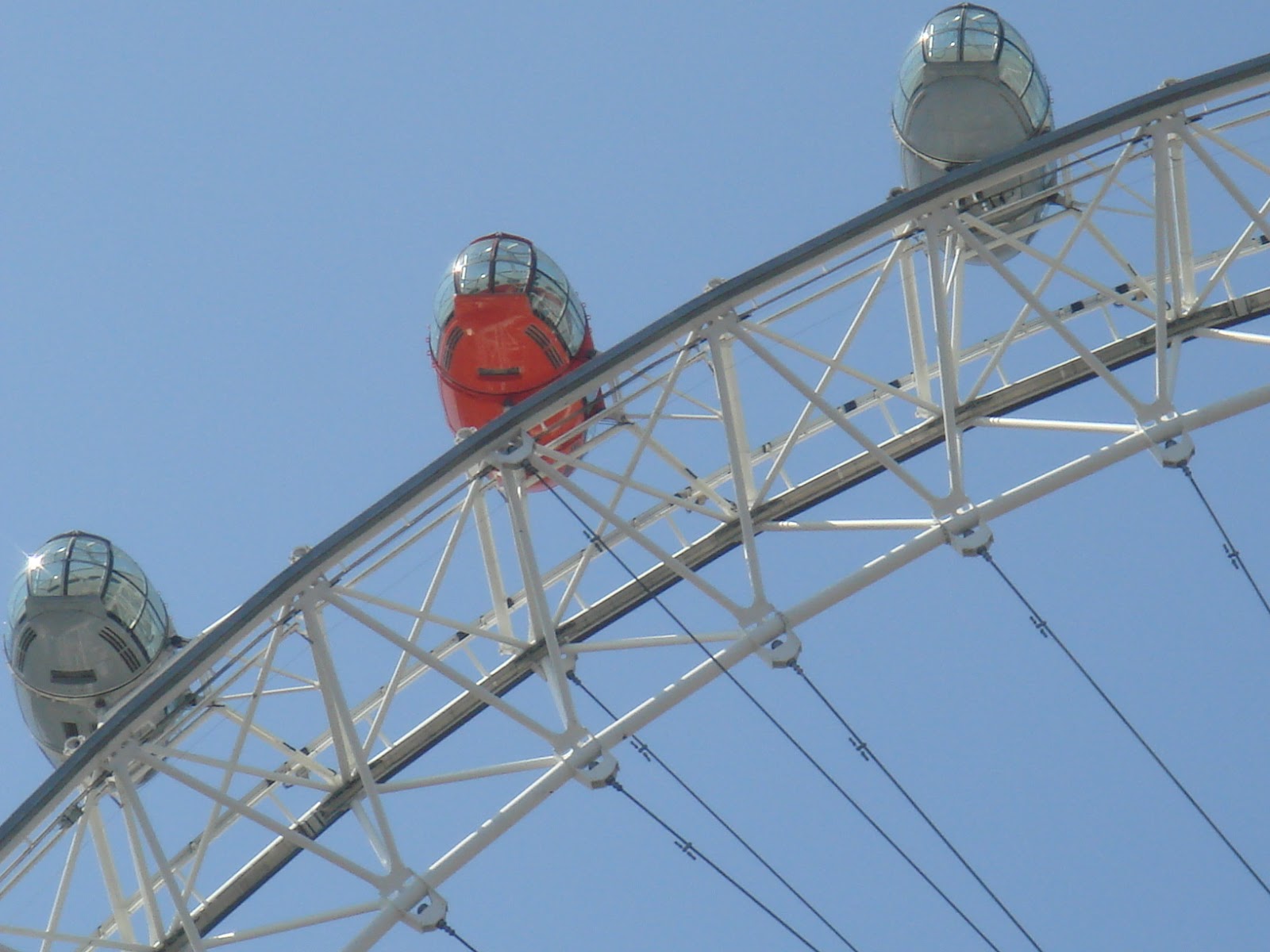
At the top left of the Eye, one of the 32 capsules is missing, due to the one by one revamp of the pods that has been on-going since mid-2009. Like so many things in London, it's due to be completed by 2012.
Yesterday, I knew just which view of it I wanted to see. It's one that I first found when heading south on a bus over Waterloo Bridge one night. I looked back over my shoulder, across the Southbank Centre, and saw the Clock Tower of the Palace of Westminster (aka Big Ben) framed by the ring of the wheel. The daylight view lacks the drama of the night sky as a background but I still find it pleasing.
At the top left of the Eye, one of the 32 capsules is missing, due to the one by one revamp of the pods that has been on-going since mid-2009. Like so many things in London, it's due to be completed by 2012.
At the top right of the Eye is the controversial orange capsule that appeared earlier this year when the Eye's sponsor changed. Lambeth Council has refused permission for the orange colour to remain and, although the London Eye is appealing the decision, this feature might well not last as long as the sponsorship.
Which might not be such a bad thing: I'm not convinced it's in the sponsors' best interests. I certainly didn't guess an energy firm. I'd have gone for a mobile phone company, followed by an airline and then a supemarket; at a push, perhaps a fizzy drink. Perhaps I've been seeing too many films if an orange pod on the Eye makes me think of an animated macaw that's undergone an enforced colour change? Anyway, aren't energy companies supposed to be green? Probably wouldn't go down any better with the council, but might provide a wry smile for a singular MP across the river.
Friday, 8 April 2011
A Day of Firsts
Primarily, today was the first day of the English cricket County Championship. Usually, the season's start in early-April is fraught with tension: not least, will the weather be clement and will anyone come and watch? This year, both potential points of concern were well and truly averted - and there is probably a link between the two. The Oval was bathed in glorious, warm sunshine and covered by a perfectly clear blue sky from dawn to dusk; and, perhaps further aided by it being a Friday, somewhere in excess of 700 people had shown up by lunchtime to watch Surrey play Northamptonshire. Of course, at a huge ground like The Oval, the place still looked very sparsely populated compared to a Twenty20 or an international match but the atmosphere was full of energy, enthusiasm, optimism and anticipation.
Personally, this was my first day of 2011 in cropped trousers, my first in sandals - which led to my first blister of the year, my first day of applying sunscreen, and my first day of getting a little bit of colour into my pallid skin. How good it all felt; well, apart from the blister - although it is already healing nicely, thank you. Bit miffed about the blister, actually, as these are my favourite, most reliable, go anywhere sandals and have never inflicted injury on me before.
Cricketwise, there were also many firsts. A somewhat inevitable situation, given that today was the first day of the season. Some occurred at The Oval - and not all were welcome.
- First wicket, first duck and first golden duck: Northamptonshire's Chaminder Vaas had Surrey's Michael Brown lbw, from his first ball faced and only the second ball of the day
- First bowling point: Essex taking the third Kent wicket
- First half-century: Durham's Mark Stoneman (51)
- First batting point: Surrey reaching 200 runs
- First century: Kent's Sam Northeast (127)
- First team out: Kent for 247 runs off 70 overs
- First five wicket haul: Yorkshire's Adil Rashid (6-77)
There were many more that could be included but this was plenty for me to note down. I was aided by the very helpful ECB Cricket mobile app. I'm attributing its persistence in believing that The Oval game had not started until about 11.20 am to first day nerves.
As usual, my simple plan for Surrey (100 without loss at lunch) went awry very quickly - to only the second ball of the day. I was not ready for this turn of events, having prepared most inadequately by predicting a wonderful season leading to promotion and encouraged by Rory Hamilton-Brown winning the toss and deciding to bat. Simple plan quickly revised to 100-1 at lunch, which was also dismissed pretty quickly, after which, as usual, I gave up formulating simple plans and just sat - oddly all day long on a surprisingly comfortable step rather than a seat - and soaked up the atmosphere and sunshine. My enjoyment was enhanced further by being allowed onto the outfield during the lunch and tea intervals. Lying flat on my stomach on the beautiful grass, reading the paper and munching sandwiches was marvellous. And thanks to Chris the Chief Steward for being so polite, patient and smiley when the time came for him to encourage me to relinquish my spot for play to resume.
At the close of play, Surrey was all out for 322 and Northamptonshire had survived four overs to be 12-0. Honours even and a fitting result to an almost perfect first day of the season. Next simple plan: for this marvellous weather to prevail throughout the season. Any wagers on how long before that one is shot to pieces?
Subscribe to:
Posts (Atom)